Jet detailing is the professional cleaning, polishing, and protection of an aircraft’s exterior and interior to aviation-safe standards. It includes surface decontamination, brightwork polishing, landing gear degreasing, cabin sanitation, and leather care. For operators in Unit #3, Mississauga, knowing what’s included helps you schedule smarter turnarounds and preserve asset value.
By Prime Auto Wash • Last updated: 2026-07-03
Overview and Table of Contents
This guide explains exactly what jet detailing includes and why it matters for safety, passenger health, and long-term asset value. You’ll see step-by-step workflows, interior and exterior checklists, best practices, tools we use on location, and real examples from our aviation projects across the GTA.
Here’s what you’ll find below. Use these quick links to jump to the section you need.
- What is jet detailing?
- What is included in jet detailing?
- Why jet detailing matters
- How jet detailing works (step-by-step)
- Types, methods, and approaches
- Best practices and compliance
- Tools and resources we use
- Case studies and examples
- Frequently asked questions
- Conclusion and next steps
What Is Jet Detailing?
Jet detailing is a specialized cleaning and preservation service for aircraft interiors and exteriors, performed with aviation-safe chemicals, equipment, and methods. It targets safety-critical areas like windows and landing gear, protects sensitive materials, and restores presentation so aircraft look and perform their best between flights.
At its core, jet detailing blends precision cleaning with preservation. Surfaces are decontaminated, polished, and protected. Interiors are sanitized, deodorized, and reset for passengers. Techniques differ from automotive work because of aircraft materials, safety rules, and the need for fast, repeatable turnarounds.
In our experience, a thorough ramp-side service touches 20–30 distinct items, from static ports masking to brightwork polishing. A cabin refresh may involve 12–18 targeted tasks, including touchpoint disinfection, leather conditioning, and carpet extraction where needed. Each action safeguards appearance and supports safe operations.
If you run a corporate shuttle or a charter, consistent detailing reduces grime buildup, keeps windows crystal clear, and mitigates premature wear on seals and gaskets. The payoff is tangible: fewer cleaning delays, steady passenger satisfaction, and surfaces that resist re-soiling longer.
Jet Detailing: What Is Included?
A complete jet detailing typically includes exterior washing or dry washing, bug and soot removal, brightwork polishing, de-ice boot conditioning, landing gear degreasing, window cleaning, interior sanitation, leather and carpet care, odor neutralization, and light protectants on approved surfaces.
When people ask “jet detailing what is included,” they’re usually trying to compare vendors or standardize turnarounds. Below is a representative scope we deliver on location in the GTA. We tailor steps to aircraft size, surface condition, and schedule.
Exterior scope (typical inclusions)
- Pre-inspection and masking: Protect static ports and sensors; verify latches and doors (5–10 minutes).
- Foam or dry wash: pH-balanced foam dwell 3–5 minutes, or waterless/ONR-style dry wash for water-restricted aprons.
- Decontamination: Bug, soot, and hydraulic-film removal on leading edges, tailcone, and belly panels.
- Brightwork polishing: Multi-stage correction on stainless and aluminum brightwork; finish with a fine jeweling pass.
- Landing gear degreasing: Controlled application; agitate with brushes; rinse or wipe per apron rules.
- Windows: Aviation-safe plexi cleaning; cross-hatch wipe to avoid micro-marring.
- De-ice boot care: Clean and condition boots; avoid residue that can reduce de-icing performance.
- Final wipe and inspection: Panel edges, seams, drains, pitot covers removed, FOD walk.
Interior scope (typical inclusions)
- Cabin reset: Trash removal, seat belts squared, light dusting of veneers and plastics.
- High-touch disinfection: Armrests, latches, tray tables, window shades, lavatory touchpoints.
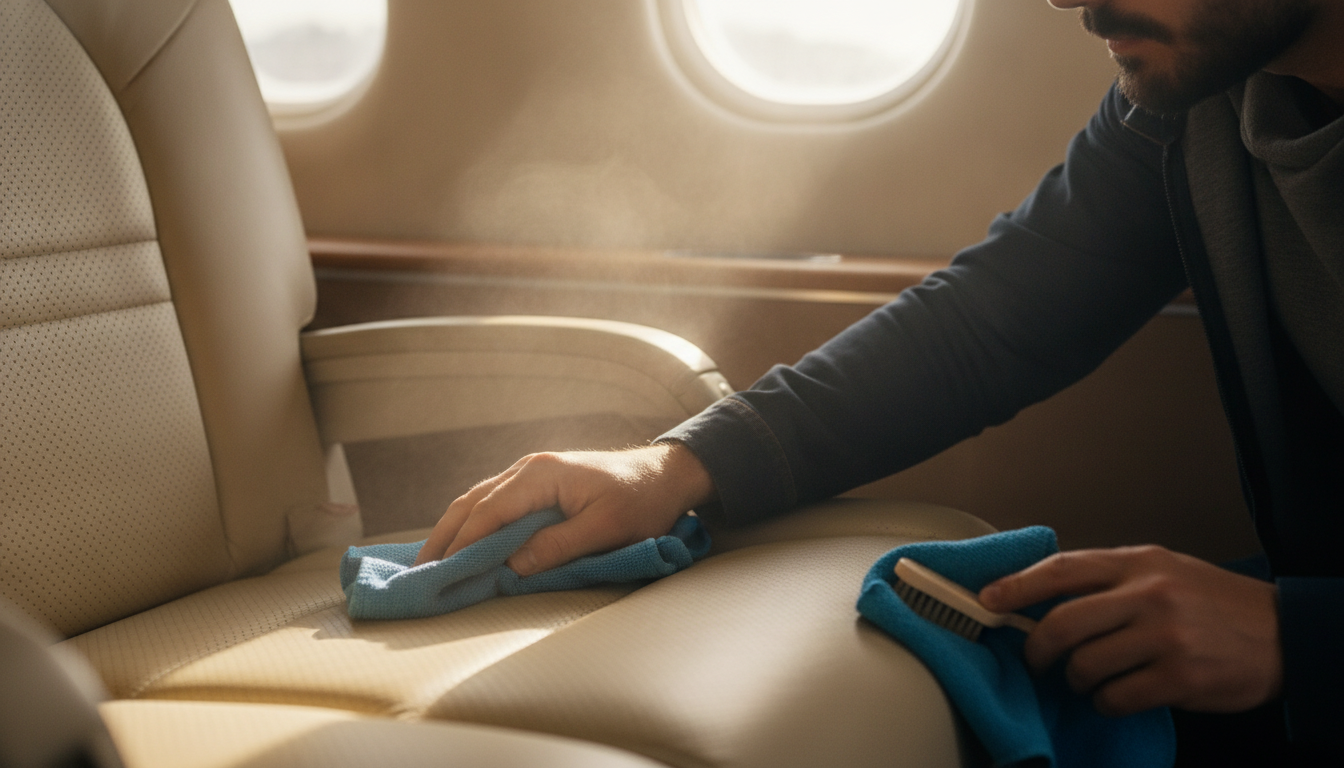
- Leather cleaning and conditioning: pH-appropriate cleaners; conditioner massaged into bolster wear zones.
- Textile care: HEPA vacuuming; spotting; hot-water extraction as needed on aisle traffic lanes.
- Galley and lavatory: Food contact-safe cleansers on galley surfaces; scale-safe products in lavs.
- Odor neutralization: Non-fragrance neutralizers; ozone only when appropriate and never with occupants present.
- Glass and screens: Microfiber techniques on monitors and mirrors; anti-streak workflow.
- Final QA: Seat map check, storage closed, catering ready, cabin presentation verified.
On many ramps, water use is limited. That’s why dry wash and rinseless chemistry have become staples. We maintain clear, labeled bottles and safety data sheets and stage absorbent mats to protect the apron. Typical exterior cycles run 60–120 minutes depending on aircraft size and soil load.
Why Jet Detailing Matters
Consistent jet detailing improves safety, passenger health, and asset value. Clear windows aid situational awareness, clean landing gear simplifies inspections, and sanitized cabins enhance customer satisfaction. Regular cycles prevent buildup that otherwise lengthens future turnarounds.
Clean aircraft are easier to inspect. When the belly isn’t coated in residue, maintenance techs can quickly identify new leaks. Landing gear that’s degreased and wiped reveals fresh seepage lines immediately. Over a month of flights, that visibility can shave minutes off each preflight check.
Passenger experience also improves. Disinfected touchpoints, conditioned leather, and odor-free cabins reduce complaint rates. For operators flying executives or guests, a consistent “showroom” cabin sets the tone before takeoff. We see repeat charters increase when cabins feel fresh on every leg.
There’s a long-term preservation angle too. Polished brightwork resists pitting, properly conditioned boots retain flexibility, and interior textiles last longer when soils don’t grind into fibers. In our work across the GTA, recurring schedules every 2–6 weeks keep aircraft presentation tight and reduce deep-clean hours later.
For context on deep-cleaning frameworks from adjacent industries, see this overview of commercial deep-cleaning checklists. While aircraft are unique, the principle of staged cleaning and verification applies.
How Jet Detailing Works (Step-by-Step)
Jet detailing follows a documented sequence: pre-inspection and masking, exterior wash or dry wash, targeted decontamination, brightwork correction, landing gear degreasing, window care, then interior sanitation, leather and textile care, and final QA. Each step has aviation-safe chemicals and tools.
Exterior workflow (ramp-side)
- Arrival and safety check: Confirm ground rules, FOD sweep, cones set; verify chocks in place.
- Mask sensitive ports: Static ports, AOA sensors, and drains protected with approved covers.
- Pre-rinse or pre-wipe: If permitted, low-pressure pre-rinse; otherwise dry-wipe heavy soils.
- Foam or dry wash: Apply foam with 2–3 minute dwell; or panel-by-panel dry wash with plush towels.
- Agitation: Soft brushes for seams and hinges; microfiber for panels; top-to-bottom method.
- Decontaminate key zones: Leading edges, tailcone soot, gear doors; use targeted solvents as required.
- Brightwork correction: 2–4 pad stages; wipe-down between passes to monitor clarity.
- Windows and lights: Aviation-safe cleaners; avoid circular motions on plexiglass.
- Final wipe/inspection: Remove masks, confirm no residue, second FOD walk.
Interior workflow (cabin)
- Reset: Remove waste, organize seat belts, dust horizontal surfaces.
- Disinfect touchpoints: Focus on latches, tables, armrests, and lavatory handles in a defined order.
- Leather: Clean with pH-appropriate solutions; apply conditioner in thin coats.
- Textiles: HEPA vacuum; treat spots; extract high-traffic lanes with measured passes.
- Galley/lav: Food-safe chemistry on galley; scale-safe for lav; polish mirrors.
- Odor control: Neutralize odors; run ozone only in unoccupied, ventilated cabins as a last resort.
- QA: Mirror checks, seat map verification, catering areas reset.
Typical exterior PSI stays under 900–1200 psi to protect seals, and foam dwell rarely exceeds 5 minutes. Inside, extraction water stays below 150–160°F to avoid delamination. These numbers keep the process safe and repeatable across corporate jets and charters.
Types, Methods, and Approaches
Jet detailing methods include wet wash, dry wash/rinseless wash, brightwork multi-stage polishing, targeted solvent cleaning on the belly, and interior disinfection with textile extraction. Method selection depends on apron rules, water access, soil load, and turnaround time.
Exterior methods
- Wet wash: Traditional foam and rinse when water use is permitted; fastest full-body reset.
- Dry/rinseless wash: Panel-by-panel cleaning; ideal for water-restrictive ramps and light-to-moderate soils.
- Brightwork correction: From cut to finish; reduces haze and restores mirror clarity on metal trims.
- De-ice boot care: Clean and condition; maintain elasticity and a uniform, dark appearance.
- Targeted degreasing: Landing gear and belly sections; control runoff with mats.
Interior methods
- Touchpoint disinfection: Dwell-based process on high-contact areas following a defined map.
- Leather restoration: Cleaners, conditioners, and light rehydration on bolster creases.
- Textile extraction: Hot-water extraction on aisle lanes; controlled passes to reduce wicking.
- Odor neutralization: Enzymatic or oxidizing neutralizers; avoid masking fragrances.
Some automotive techniques do translate. For example, our interior detailing framework informs how we sequence high-touch areas in cabins. But aviation adds constraints: delicate plexi, restricted water, and strict apron protocols.
Best Practices and Compliance
The best jet detailing programs document chemistry, protect sensitive components, control water and runoff, and verify results with checklists. Trained teams mask ports, cap drains, and follow apron rules. Final QA confirms materials are residue-free and presentation meets operator standards.
- Chemical discipline: Label bottles; keep Safety Data Sheets in the van; test on inconspicuous areas first.
- Water control: Use mats and wet-vacs; select dry wash where required; avoid pooling around gear.
- Masking: Cover static ports, AOA sensors, and drains before foam or rinse.
- Tooling: Dedicated aviation microfibers for windows; separate wheel/gear brushes from panel towels.
- Sequencing: Top-to-bottom, forward-to-aft to prevent rework; brighten metal after decontamination.
- Documentation: Pre/post photos; sign-off sheets; note any observed defects for maintenance.
Across industries, degreasing best practices emphasize controlled application and capture—see this general overview of degreasing methods for the logic behind staged removal. On apron jobs, we adapt these principles with aviation-safe chemistry and strict runoff control.
Tools and Resources We Use
We bring a self-contained mobile unit with power, water, and professional tools: steam cleaner, pressure washer, vacuums, air compressor, and carpet extractor. Aviation-safe chemicals, labeled bottles, mats for runoff control, and dedicated window microfibers round out our ramp-ready kit.
Prime Auto Wash operates a fully self-contained mobile van, so we don’t need site hookups. That’s crucial when you’re on a tight ramp window or working at FBOs with strict water policies. Our staging typically includes cones, mats, lighting, and a documented tool layout for efficiency.
Here’s what we typically stage within 10–12 minutes of arrival:
- Two pro-grade pressure sprayers (low-PSI, foam and rinse) where permitted.
- Steam unit for galley/lav sanitizing and crevice work.
- Carpet extractor with controlled heat and suction presets.
- Brightwork polishers with 2–4 pad options and speed control.
- Dedicated aviation glass towels and interior microfibers by color code.
- Absorbent mats and a compact wet-vac for runoff capture.
If you’re comparing vendors, our mobile detailing overview shows how a self-contained unit cuts setup time and keeps workflows predictable on-site, whether it’s a jet, RV, or fleet van.
Local considerations for Unit #3
- If you stage near the Mississauga Chinese Centre, plan early-morning arrivals to avoid peak lot traffic when moving equipment.
- Winter ramps get messy fast. Schedule exterior resets after de-icing operations and add a quick boots wipe mid-day.
- Apron access windows can be short. Our self-contained unit reduces setup to minutes, keeping you on slot.
Process and Coverage Table
A structured process keeps ramp work safe and efficient. This table shows common aircraft areas, typical actions, tools, and estimated times. We adapt coverage to aircraft size, soil level, and apron rules while protecting sensitive components.
| Area | Typical Action | Primary Tools | Est. Time |
|---|---|---|---|
| Fuselage panels | Foam or dry wash, panel wipe | Foam gun, plush towels | 25–45 min |
| Leading edges | Bug/soot removal, protectant | Pre-soak, microfiber | 10–20 min |
| Brightwork | 2–4 stage polish | DA polisher, pads | 30–60 min |
| Landing gear | Degrease, wipe, inspect | Solvent, brushes | 15–25 min |
| Windows | Aviation plexi clean | Glass towels | 8–12 min |
| Cabin touchpoints | Disinfect and reset | EPA-style process | 15–25 min |
| Leather seating | Clean and condition | Leather kit, applicators | 20–35 min |
| Textiles | Vacuum, extract lanes | HEPA vac, extractor | 15–30 min |
Case Studies and Examples
Our GTA aviation projects range from quick-turn cabin resets to full exterior correction and brightwork restoration. These examples show how schedule, soil level, and apron rules shape the jet detailing plan without compromising safety or presentation.
Executive shuttle, quick-turn cabin
A weekday commuter shuttle needed a fast reset between legs. We mapped a 35–45 minute cabin-only cycle: trash removal, touchpoint disinfection, leather wipe and condition, aisle lane extraction, and glass polish. With a tight slot, our self-contained unit kept setup to minutes.
Corporate jet, exterior + brightwork
After weeks of flying, leading edges and the tailcone had soot and bug buildup, and brightwork had haze. We performed a dry wash to honor ramp rules, followed by a three-stage brightwork correction. Windows and boots were finished last. The aircraft regained its mirror finish.
Charter aircraft, deep interior sanitation
Post-event cabin odors required targeted neutralization. We combined enzymatic deodorizers with controlled hot-water extraction on high-traffic zones. Ozone was reserved for an unoccupied window after ventilation planning. The cabin returned to a clean, neutral scent for the next client.
If you want a refresher on how professional techniques differ from basic washing, our article on detailing vs. car washing outlines the discipline behind sequencing and QA—principles we carry into aircraft work.

How Prime Auto Wash Fits Into Aviation Care
We combine aviation-safe processes with our mobile, self-contained setup to deliver ramp-ready exterior and interior jet detailing across the GTA. Clients get dealership-level results on-site without hookups, plus flexible scheduling for quick turns or full resets.
Prime Auto Wash serves Mississauga, Brampton, Toronto, and the broader GTA. Our aviation projects benefit from the same disciplined systems we use for premium vehicles—ceramic coatings, paint correction principles, and interior sanitation playbooks—adapted to aircraft materials and apron rules.
Start by exploring our dedicated aircraft detailing page for scope and scheduling. If cabin care is your focus, compare our interior detailing package and the advanced Interior Detailing Pro to see how we translate deep-clean discipline into aviation cabins.
For broader context on professional outcomes, our guide to the benefits of professional detailing explains why trained teams, process control, and QA checklists consistently outperform ad-hoc cleaning—especially when the clock is running between legs.
Interested in an at-location setup? Review how we deploy in our mobile detailing overview. The same power-and-water independence that helps at condos or office parks also streamlines apron work near Unit #3 and around Westacres Park.
Jet vs. Car Detailing: Key Differences
Jet detailing prioritizes aviation-safe chemistry, strict water control, and protection of sensitive components. Car detailing fundamentals still help, but aircraft materials, plexiglass care, apron rules, and quick-turn scheduling create unique workflows and QA standards.
- Materials: Aircraft plexi, de-ice boots, and brightwork require specific cleaners and pads.
- Water use: Many ramps restrict water; dry/rinseless methods become primary.
- Safety: Masking ports and drains, FOD control, and sequencing reduce risk.
- QA speed: Turnarounds may be under an hour; processes must be crisp and documented.
If you’re new to pro workflows, this general look at deep-cleaning stages mirrors our stepwise approach: assess, pre-treat, clean, correct, protect, and verify. The core idea—work clean, validate often—maps well to aircraft.
Plan a Ramp-Ready Detailing Cycle
Need a fast cabin reset or a full exterior correction? Our self-contained mobile unit brings power, water, steam, and extraction to your location. We adapt to apron rules while delivering consistent, aviation-safe results across the GTA.
Get a no-pressure consultation. Tell us your aircraft type, apron constraints, and turnaround window. We’ll map a safe, efficient sequence for your next cycle.
Frequently Asked Questions
These quick answers cover scheduling, methods, and safety for jet detailing. Each response is concise, direct, and focused on how we work ramp-side in the GTA while protecting sensitive aircraft components and meeting presentation standards.
What’s typically included in a jet detailing service?
A standard service covers exterior wash or dry wash, bug and soot removal, brightwork polishing, landing gear degreasing, aviation window cleaning, de-ice boot care, and a cabin reset with touchpoint disinfection, leather care, textile extraction as needed, and odor neutralization.
How long does a full jet detail usually take?
Exterior cycles often run 60–120 minutes depending on size and soil level. Cabin resets range from 30–60 minutes. Deep brightwork correction or heavy interior extraction can extend timelines. We adapt to your apron access window and prioritize safe, repeatable steps.
Do you use wet washing or dry washing on ramps?
Both are available. On water-restricted ramps, we default to dry/rinseless wash with plush towels and panel-by-panel sequencing. Where permitted, a controlled wet wash speeds full-body resets. Either way, we protect ports and manage runoff safely.
Is ozone treatment safe inside aircraft cabins?
Ozone is a last-resort odor tool and must be used with strict controls: no occupants present, short exposure windows, and full ventilation before re-entry. We prefer enzymatic neutralizers first and only consider ozone after evaluating materials and schedule.
Can you work at my location near Unit #3?
Yes. Our self-contained mobile unit brings power, water, steam, and extraction to your location. We coordinate apron access and follow ramp rules. Share your window and aircraft type, and we’ll stage a safe, efficient detailing sequence.
Conclusion and Next Steps
Jet detailing includes a defined set of interior and exterior actions designed for aviation safety, presentation, and preservation. When sequenced correctly, these steps shorten turnarounds, improve inspections, and keep cabins guest-ready across busy GTA schedules.
Key takeaways
- “Jet detailing what is included” boils down to consistent exterior cleaning, brightwork care, landing gear degreasing, and a methodical cabin reset.
- Water restrictions, plexi care, and masking make aviation workflows different from car detailing.
- A self-contained mobile setup keeps ramp work efficient and repeatable near Unit #3.
Ready to plan your next cycle? Explore our aircraft detailing options or review how we mobilize in our mobile service overview. We’ll align chemistry, tools, and sequencing with your apron rules and turnaround goals.